When Will CERN Be Turned On In 2026?
 AND Editorial Team
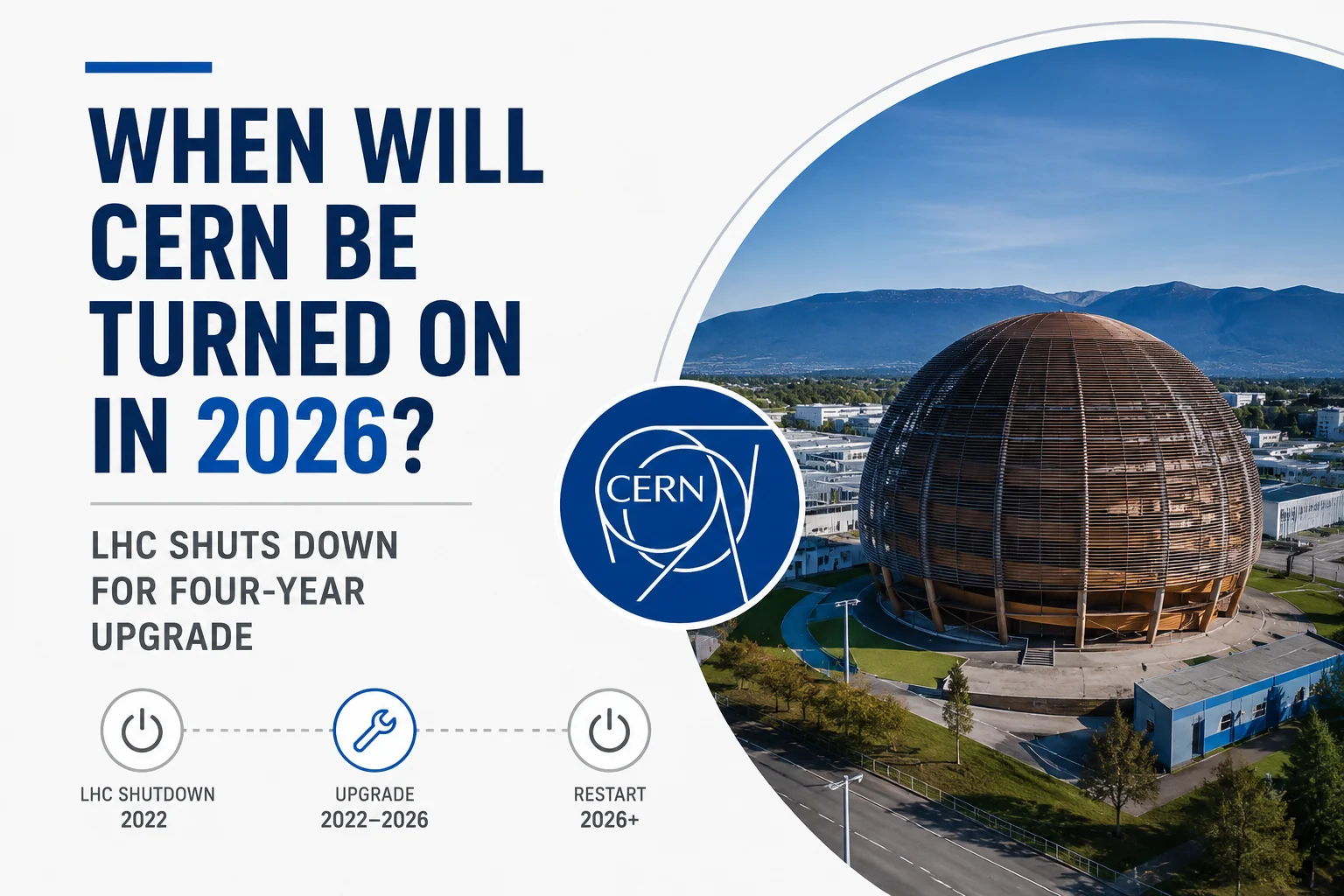
Many people search for one question: When will CERN be turned on in 2026? The simple answer is this. CERN does not plan a new LHC turn-on later in 2026. The Large Hadron Collider already turns on for its final Run 3 period in March 2026. CERN says stable beams for physics data taking start on March 7, 2026.
That means the 2026 question has a different answer than many people expect.
CERN does not move toward a new start in late 2026. It moves toward a major shutdown. The LHC shuts down on June 29, 2026. CERN now starts Long Shutdown 3, which prepares the machine for its next version.
So the answer depends on what readers mean by “CERN.” If they mean the LHC physics run, it already starts in March 2026.
If they mean the LHC shutdown, it starts at the end of June 2026. If they mean the next full restart, CERN targets 2030.
Also Read: NASA Swift Telescope Rescue Mission
This topic creates confusion because people often use “CERN” and “LHC” as the same word. CERN is the research lab in Europe. The Large Hadron Collider is the biggest machine at CERN. It is the 27-kilometer particle accelerator that smashes proton beams together.
So CERN does not fully “turn off” in 2026. The LHC turns off. CERN continues as a research center. Teams continue work on other accelerators, detectors, labs, and upgrade projects.
CERN says other accelerators continue to operate through July and August 2026. They begin their own major work in September 2026.
This is the unique point many articles miss. The LHC shutdown is not the same as CERN shutting down. CERN keeps working, but the LHC stops collision work for a major rebuild.
The LHC starts its final 2026 run in March. CERN says stable beams begin on March 7, 2026. Stable beams means the machine is ready for physics data taking. The detectors can collect useful collision data after this stage.
This is not like turning on a light switch. The LHC needs careful steps before full physics work starts.
Operators prepare the machine. They test systems. They inject beams. They check beam stability. They raise intensity step by step. Only after that does CERN declare stable beams.
That is why the phrase “turned on” is too simple. The LHC goes through a full start-up process. It does not start in one second.
The LHC shuts down on June 29, 2026. CERN says the LHC is now shut down. Teams will dismantle 1.2 kilometers of the accelerator to install new High-Luminosity LHC equipment.
That date matters because it starts a new phase. The 2026 run is not long. CERN calls it short but intense. It gives scientists one final Run 3 period before the upgrade begins.
The shutdown is planned. It is not a surprise failure. CERN stops the LHC so engineers can upgrade the machine and prepare it for more collisions in the future.
Long Shutdown 3 is the major upgrade break for the LHC.
CERN uses LS3 to turn the current LHC into the High-Luminosity LHC. The upgrade needs new equipment, new tunnel work, new magnets, new superconducting cavities, stronger protection systems, and new electrical links.
The goal is simple. CERN wants more particle collisions inside the experiments. More collisions give scientists more data. More data helps them study rare events. It also helps them study the Higgs boson and other known particles with more detail.
LS3 is not only repair work. It is a major rebuild for the next science era.
The LHC is expected to return in 2030. CERN says the High-Luminosity LHC, also called Run 4, is planned to start in June 2030.
This means there is no normal LHC physics restart for the rest of 2026. There is also no full restart in 2027, 2028, or 2029.
CERN may restart some parts of the accelerator complex before the LHC returns. But the full LHC physics program comes back with the High-Luminosity LHC in 2030.
This is the key answer for readers who ask, “When will the Hadron Collider be turned on?” It runs in early 2026. It shuts down on June 29, 2026. It comes back in 2030.
CERN shuts down the LHC because the machine needs major upgrades. The High-Luminosity LHC will create a higher collision rate. This helps scientists gather more data. It also improves the chance of seeing rare physics events.
CERN says LS3 includes the installation of new equipment for the High-Luminosity LHC. This includes more powerful focusing magnets and crab cavities.
These parts help control the proton beams more carefully. They also help increase the number of useful collisions. The upgrade also affects the detectors. Major experiments such as ATLAS and CMS need improved systems to handle more collision data.
So the shutdown is not a pause without purpose. It is the work that allows the LHC to return stronger.
CERN uses the 2026 run for final science and machine tests.
The run includes proton collisions and lead-ion collisions. It also includes a high-intensity proton test at the end of the run. CERN says these tests help study the LHC under conditions closer to the High-Luminosity LHC.
This makes the final run more valuable. The 2026 run is not only a farewell. It also gives CERN data for the upgrade. Engineers use the last tests to study limits and risks before the long shutdown work begins.
This point often gets missed. The final run does not only collect physics data. It also prepares the machine for its future form.
The 2026 schedule feels confusing because different parts of CERN stop at different times.
The LHC stops at the end of June. Other accelerators continue into July and August. Their major shutdown work starts later in 2026. This creates mixed headlines.
Some reports say CERN shuts down. Some say CERN keeps running. Both can sound true, but they describe different parts of the laboratory.
The best way to explain it is simple. The LHC stops first. CERN keeps working. Other accelerators stop later. The whole complex then moves deeper into LS3 upgrade work.
The CERN shutdown gets attention because the LHC is one of the most famous science machines in the world. The LHC helps confirm the Higgs boson in 2012. Since then, it continues to study particle physics at high energy.
Now the machine enters a long upgrade phase. That sounds dramatic because the LHC will stay away from normal physics runs for years.
But this is normal for a machine of this size. The LHC needs long shutdowns for major work. Engineers cannot replace key parts while the accelerator runs. They need time to open sections, remove equipment, install new systems, test safety systems, and prepare the beams again.
That is why a four-year gap does not mean CERN stops science. It means CERN invests in the next stage of science.
Most articles answer only one question. They say the LHC shuts down for four years. That is true. But it misses three useful points.
The final Run 3 period gives CERN science data and machine test data. The shutdown then gives CERN time to install equipment that can raise the collision rate after 2030. So the best way to view 2026 is not as a normal operating year. It is a bridge year.
Readers should watch CERN’s LS3 updates. CERN now begins the upgrade work. Teams will dismantle parts of the accelerator and install new High-Luminosity LHC equipment.
The next major public milestone is not another LHC turn-on in 2026. The next big milestone is the progress of LS3.
The larger milestone comes in June 2030, when CERN plans to start the High-Luminosity LHC.
For now, the answer is clear. CERN’s LHC turns on for physics in March 2026. It turns off on June 29, 2026. It enters Long Shutdown 3. It aims to return in 2030 with a stronger machine and a bigger data goal.