Malik Beasley Case Update: Federal Betting Charges Put NBA Integrity Back Under Pressure
 Nikhil Mehta
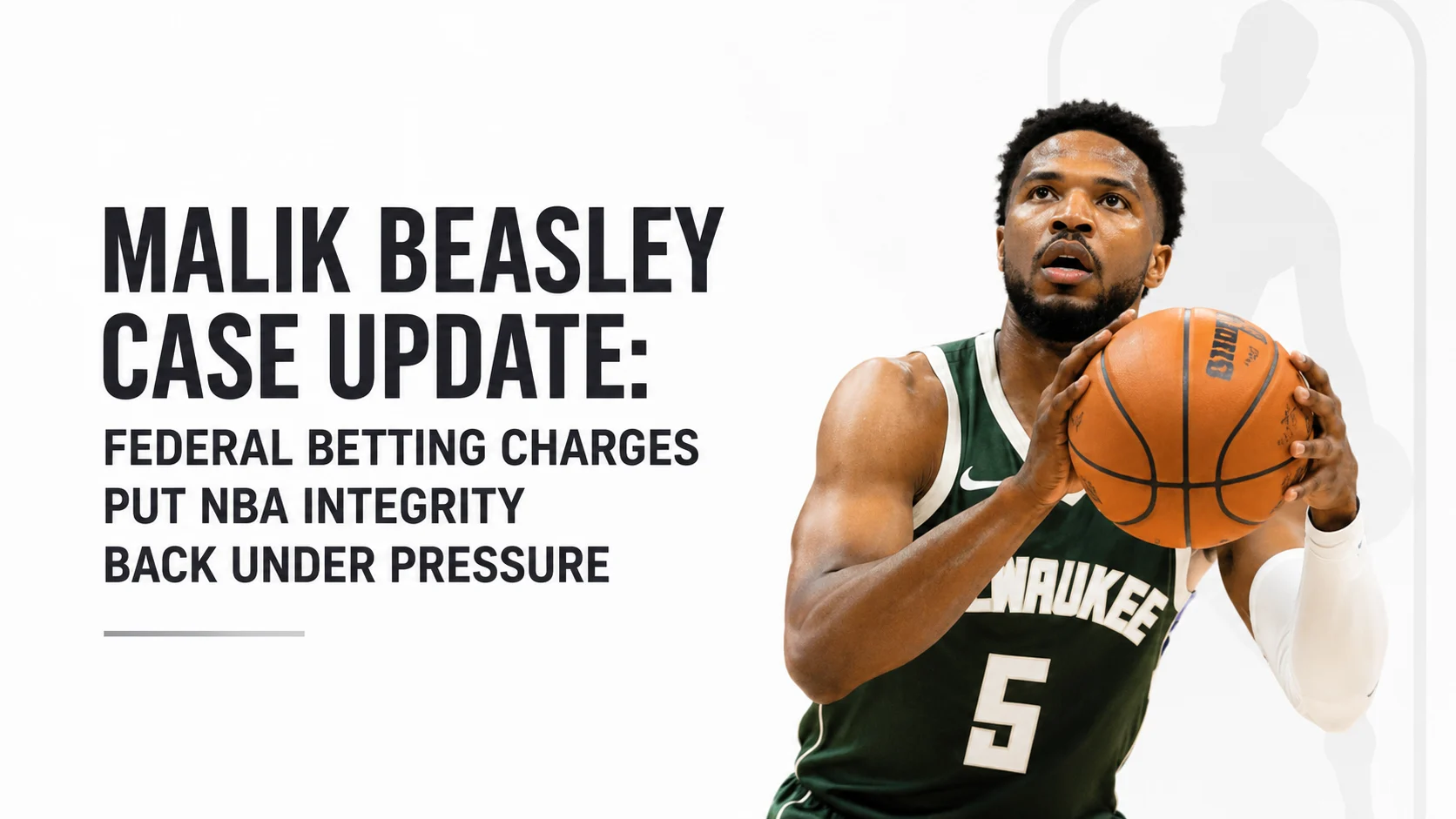
Malik Beasley is now at the center of a major federal sports betting case. The U.S. Attorney’s Office for the Eastern District of New York says a federal court in Brooklyn unseals an indictment against six people. The list includes former NBA players Malik Beasley and Edward Davis.
It also includes William Brown, Robert Gorodetsky, Ernesto Plascencia, and current NBA player agent Paolo Zamorano. Prosecutors charge them with wire fraud conspiracy, bribery in sporting contests, honest services wire fraud conspiracy, and money laundering conspiracy.
The case focuses on alleged bets tied to Beasley’s game stats. Prosecutors say the group uses inside information about Beasley’s planned performance. They say the group then places illegal wagers to make money.
This case does not only deal with normal sports betting. It deals with a more serious claim. Prosecutors say a player changes his performance so others can win bets. That claim hits the heart of sports trust.
Also Read: Carl Rinsch Sentencing: 47 Ronin Director Gets 30 Months In Netflix Fraud Case
Federal prosecutors say Beasley plays for the Milwaukee Bucks during the 2023-24 season. They say he agrees with Davis before some games that he will perform in a certain way.
The indictment says Beasley at times plans to underperform. It also says he at times plans to overperform on some stats. Prosecutors say the key stats include rebounds and points.
The DOJ says Davis acts as Beasley’s “gatekeeper” in the alleged scheme. Prosecutors say Davis shares this non-public information with others. They say those people then place bets based on the inside information.
The DOJ says the group places hundreds of thousands of dollars in fraudulent wagers through multiple betting operators.
This matters because prop bets focus on single player numbers. A bettor does not need a team to win. A bettor only needs one player to reach or miss a number. That makes prop bets a weak spot for modern sports.
The DOJ press release names three Bucks games in the case. The first game is Milwaukee Bucks vs Cleveland Cavaliers on January 26, 2024. Prosecutors say Beasley tells Davis that he plans to underperform on rebounds. They say Davis then shares that information with others.
The second game is Milwaukee Bucks vs Charlotte Hornets on February 27, 2024. Prosecutors say Beasley plans to underperform on points and overperform on rebounds. The third game is Milwaukee Bucks vs Los Angeles Clippers on March 10, 2024. Prosecutors say Beasley plans to overperform on rebounds.
These details make the case different from a basic betting rule issue. The case does not only ask whether a player bets. It asks whether a player changes parts of his game for betting profit.
The indictment includes several federal charges.
The charges include wire fraud conspiracy. They also include bribery in sporting contests. They include honest services wire fraud conspiracy and money laundering conspiracy.
The DOJ says each defendant faces up to 20 years in prison on the wire fraud conspiracy counts if convicted. It says each defendant also faces up to 20 years on the money laundering conspiracy count. The bribery in sporting contests count carries up to five years if convicted.
These are maximum penalties. They do not mean any person receives that sentence.
The court process now decides what prosecutors can prove.
ESPN reports that Beasley and Davis are indicted in a federal gambling investigation. Yahoo Sports also reports that Beasley’s attorney says the government is coordinating a voluntary surrender for Beasley this week.
This point matters. An indictment is not a conviction. It means prosecutors bring formal charges. It starts the next legal stage.
Beasley still has the right to fight the charges in court.
Ed Davis is a former NBA player. Prosecutors place him near the center of the alleged scheme.
The DOJ says Davis works with Beasley before games. It also says Davis shares the inside information with other co-conspirators. Prosecutors say Beasley receives bribes through reduced or paid gambling debts to Davis.
This claim gives the case a personal angle. It does not describe a stranger trying to reach a player. It describes a former teammate relationship.
That is one of the most important parts of this case. Leagues can block outside threats. But trusted personal links are harder to police.
NBA fans now talk about this case because it touches several fears at once.
First, fans worry about game trust. They want to believe every player competes honestly.
Second, bettors worry about unfair markets. They fear that insiders know something they do not know.
Third, teams worry about locker room pressure. A player can carry debt, stress, and outside contact into the season.
Fourth, the league faces a public image issue. The NBA now lives in a sports world where betting ads appear everywhere. Fans see betting lines during games. They hear prop talk on shows. They watch odds change in real time.
That makes this case bigger than one player.
It tests whether the league can protect the game in a betting-heavy era.
Many reports focus on the names in the indictment. But the deeper issue is the type of bet.
Prop bets make small player actions valuable. A rebound matters. A shot attempt matters. A late assist matters. A few minutes on the bench matters.
This creates a new risk.
A full game is hard to fix. A single stat is easier to influence.
A player can miss one rebound chance. A player can avoid one shot. A player can chase one board. A player can change effort in a small way.
That does not mean every odd play is suspicious. Bad games happen. Strange stat lines happen.
But prop betting gives financial meaning to small moments that fans once ignored.
That is why this case feels so serious. It shows how a betting market can turn normal basketball details into legal evidence.
The indictment also names Paolo Zamorano. The DOJ describes him as a current NBA player agent. This adds another layer. Sports integrity does not only depend on players. It also depends on agents, friends, trainers, lenders, and business contacts.
A player may not act alone. A betting case can move through small circles around the player. That is a major concern for teams. They do not only need to educate players. They also need to watch the support network around players.
This is the part many quick reports miss. The modern betting risk is not just inside the locker room. It is also around the locker room.
The NBA has strict betting rules for players and team staff. The league also has strong reason to protect its product. But this case presents a harder question.
Can a league stop betting risk when legal betting markets grow fast? The NBA can punish players. It can improve training. It can monitor betting patterns. It can work with sportsbooks. It can ban certain people from team spaces.
But the league cannot fully control private debt. It cannot fully control every friend. It cannot fully control every off-court message. That is why this case may push the NBA toward tougher rules on player prop bets.
The league and betting companies may also face pressure to limit some low-level player prop markets. These markets may create more risk than value.
The case is serious. But the charges remain allegations. The DOJ clearly says the defendants are presumed innocent unless and until proven guilty.
That line matters. Fans can discuss the case. Analysts can debate the impact. The league can review its rules. But the court still decides guilt. The next steps may include surrender, arraignment, pretrial hearings, evidence fights, and possible plea talks or trial. Those steps can take time.
The Malik Beasley case arrives at a tense time for sports. Sports betting is now normal for many fans. Apps make betting fast. Props make betting more personal. Social media makes every strange play go viral.
That creates a new problem. Fans now watch games with suspicion. A missed shot can become a theory. A late rebound can become a clip. A bad stat line can become a scandal claim.
This hurts the game even before a court reaches a verdict. The NBA now faces a trust challenge. It must protect players from bad influences. It must protect fans from doubt. It must protect games from betting pressure.
The Beasley case shows that the biggest threat may not come from the final score. It may come from one number on a player stat sheet. For the NBA, that is the real warning.