Supreme Court Mail-In Ballots Ruling
 AND Editorial Team
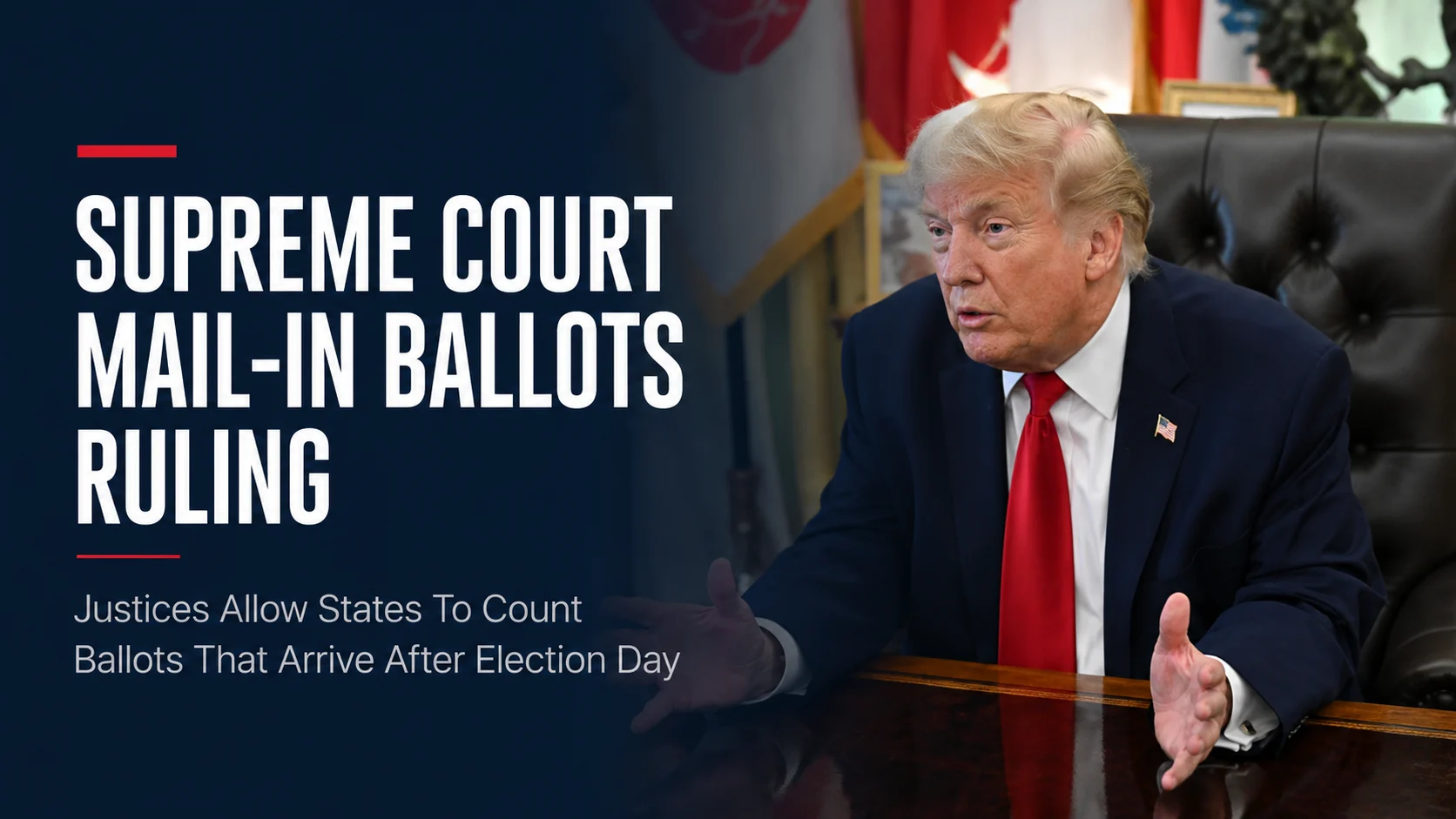
The U.S. Supreme Court delivers a major ruling on mail-in ballots. The court says states can count some mailed ballots that arrive after Election Day if state law allows it and the ballot carries a timely postmark. The 5-4 ruling rejects a Republican-led challenge to a Mississippi law. That law allows certain ballots to arrive after Election Day and still count if voters mail them on time.
The ruling does not create one national mail voting rule for every state. It lets states keep their own rules where those rules allow a post-election receipt window. AP reports that the decision preserves rules in nearly 30 states and the District of Columbia.
The case matters because it arrives only months before the 2026 midterm elections. A ruling the other way could force many election offices to change rules fast. The court avoids that sudden change.
Justice Amy Coney Barrett writes the majority opinion. Chief Justice John Roberts joins her. The court’s three liberal justices also join the majority. That creates a 5-4 result.
Four conservative justices dissent. Justice Samuel Alito writes for the dissenting side. He warns that the ruling may raise more election law questions and hurt public confidence in election integrity.
This split surprises many conservatives. Barrett is a Trump appointee. Roberts also often sits at the center of major institutional rulings. Their votes make this case more than a normal left-right decision.
The ruling shows that the court does not accept the strictest reading of federal Election Day law. The majority says federal law sets the day by which voters cast ballots. It does not clearly set one national receipt deadline for every mailed ballot.
Also Read: Carl Rinsch Sentencing: 47 Ronin Director Gets 30 Months In Netflix Fraud Case
The case starts in Mississippi.
Mississippi allows some mailed ballots to count if they carry a timely postmark and arrive within the state’s allowed post-election period. Reuters reports that Mississippi’s rule allows those ballots to arrive up to five business days after a federal election.
The Republican National Committee and other plaintiffs challenge that rule. They argue that federal Election Day laws require state officials to receive ballots by Election Day. A lower federal court agrees with that argument. The Supreme Court now reverses that result.
The case has national weight because many other states use some form of late-arrival rule for mailed ballots. AP reports that in just over half of those states, the rule applies only to ballots from military and overseas voters.
That point matters. The public debate often treats all late-arriving ballot rules as the same. They are not the same. Some rules apply broadly. Some rules apply only to special voter groups.
The ruling gives election officials a clearer path before the 2026 midterms. Election offices need time to prepare ballots, train workers, test systems, print instructions, and set counting plans. A late rule change can create confusion for workers and campaigns.
AP reports that the decision spares officials from the problem of changing ballot rules only months before the midterm elections.
This is one unique angle many competitors miss. The ruling is not only about who wins a legal fight. It is also about election operations.
Election law does not work only in courtrooms. It works in county offices, mail rooms, sorting rooms, and ballot-counting centers. A court order can change legal theory in one day. But election systems need weeks or months to adjust.
The Supreme Court’s decision keeps many existing systems in place.
President Donald Trump strongly criticizes the decision. Reuters reports that Trump calls the ruling a “tremendous loss.” He also renews his call for Congress to pass the SAVE America Act. That bill would add stricter voting rules at the federal level.
Republicans argue that Election Day should mean a clear cutoff. They say counting ballots after Election Day can delay results and raise concerns about trust. RNC leaders also use the ruling to argue for new national election rules.
The dissent gives that argument more force. Alito says the majority creates risks for confidence in elections. His view now becomes a key talking point for conservatives who want tighter federal rules.
The political fight does not end with the ruling. It moves to Congress.
Democrats and voting rights groups praise the ruling. They say voters should not lose ballots because of mail delays after they follow the rules. Reuters reports that voting rights advocates frame the ruling as protection for seniors, rural voters, disabled voters, and military and overseas voters.
Senate Democratic Leader Chuck Schumer also welcomes the ruling. He says Democrats will protect fair elections as the midterms approach.
Supporters view the ruling as a voting access decision. They say it protects voters who use mail ballots for valid reasons. They also say the postmark rule creates a clear marker that a ballot is sent on time.
That is the main clash. Republicans focus on receipt and speed. Democrats focus on casting and access.
Many reports frame the ruling as a simple win or loss for one party. That misses the deeper issue. The real fight is over the meaning of time in elections. One side says a ballot must arrive by Election Day to count. The other side says a ballot is timely when a voter casts it by Election Day under state rules.
That difference sounds small. But it affects thousands of ballots in some states.
Another missed point is the military and overseas voter issue. AP notes that in many affected states, the more flexible rule applies only to military and overseas voters.
That changes the public debate. The case is not only about ordinary mail voting. It also affects voters who may face long mail delays because of service, travel, or distance.
A third missed point is the lower court map. Reuters reports that the 5th Circuit ruling applied directly only in Mississippi, Louisiana, and Texas. But it still raised questions for states with similar rules.
So the Supreme Court ruling removes a wider legal cloud, even though the case starts with Mississippi.
The ruling does not force every state to count late-arriving mail ballots. It does not create a new national grace period. It does not end state power to set mail ballot rules.
It also does not stop Congress from changing federal law. AP reports that Barrett says Congress can act if lawmakers want a national answer on ballot receipt deadlines.
This is important because social media claims can make the ruling sound bigger than it is. The court does not say every late ballot must count. It says federal Election Day law does not block the state rules at issue.
That leaves the next fight to lawmakers.
The SAVE America Act now becomes a bigger part of the story. Trump and other Republicans push the bill after the ruling. Reuters reports that the bill would require photo ID to vote and proof of citizenship to register. It faces Democratic opposition in the Senate.
This gives Republicans a simple message. They can say the court will not tighten the rules, so Congress must do it.
Democrats have a different message. They say the bill can make voting harder for eligible citizens. Reuters reports that Democrats accuse Trump of pushing steps that can reduce access, especially for groups that often support Democrats.
That means the Supreme Court case now becomes a campaign issue. It also becomes a legislative issue.
The ruling may shape future election lawsuits. The majority gives states room to use postmark-based rules. But the 5-4 split shows that the legal fight remains close. One changed vote could shift the result in a future case.
The dissent also gives future challengers a legal path. It argues that federal law should require receipt by Election Day. That argument loses now. But it does not disappear.
The ruling may also push more states to review their own mail ballot rules. Some may protect grace periods. Others may cut them. Some may limit them to military and overseas voters.
The court answers one question. It does not end the national fight over mail voting.
The Supreme Court mail-in ballots ruling now sits at the center of the 2026 election debate. Voting rights groups see it as a guardrail for access. Trump and Republicans see it as a loss for election integrity. Election officials see it as a way to avoid last-minute rule changes before the midterms.
The strongest angle is not only legal. It is practical.
The court keeps many existing systems stable. But it also fuels a new political fight over whether Congress should set a stricter national rule.
That makes the ruling a rare case where both sides get a clear message. States keep their current power for now. Congress gets the next chance to change the law.