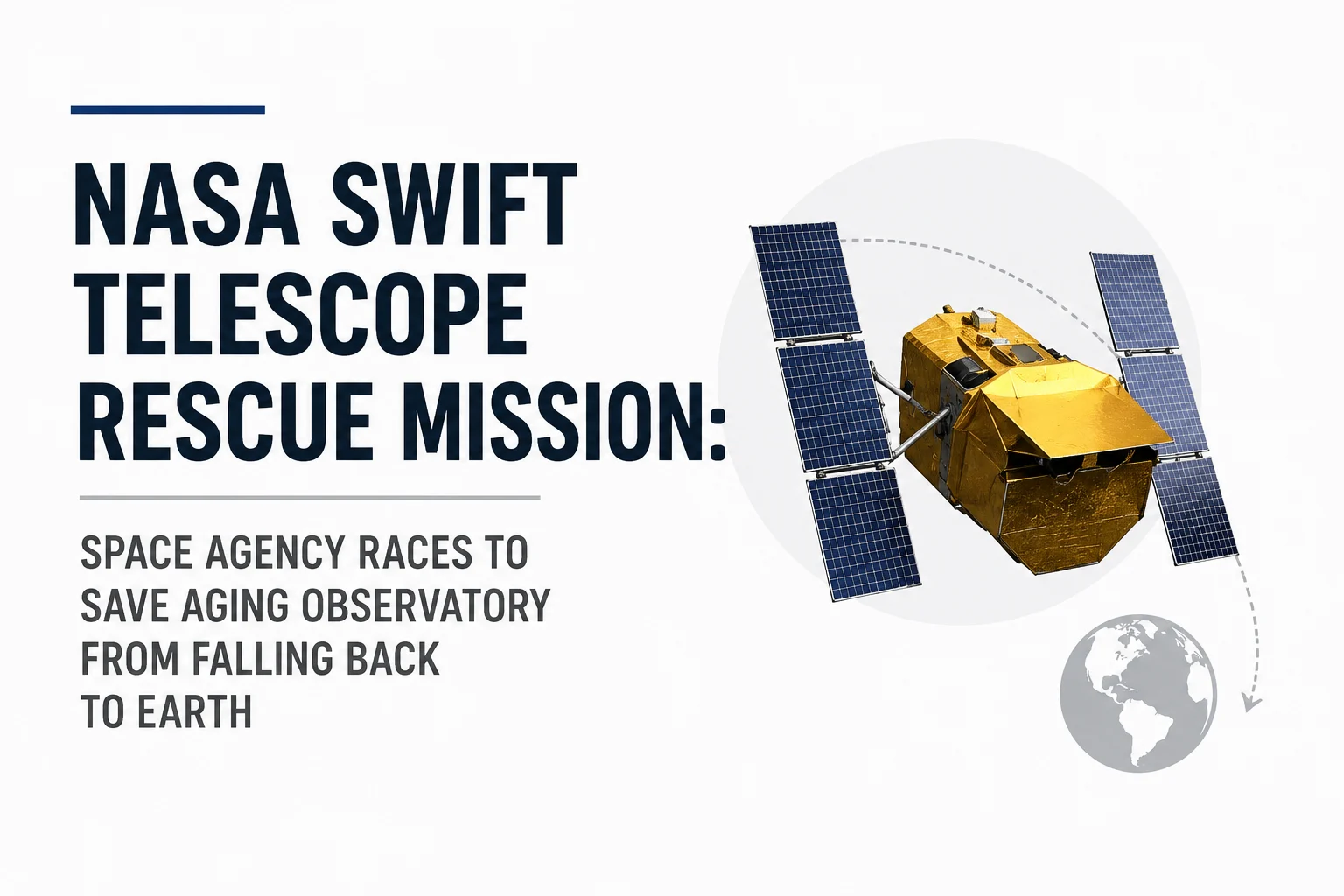
NASA Swift Telescope Rescue Mission
 AND Editorial Team
NASA starts a rare space rescue mission to save the Neil Gehrels Swift Observatory from falling back to Earth.
Swift is a NASA space telescope. It studies powerful space events. It helps scientists track gamma-ray bursts. These bursts are among the strongest explosions in the universe.
The telescope launches in 2004. It works far longer than its first planned mission. It still gives useful data to scientists. But it now loses altitude. Earth’s upper air creates drag. That drag pulls Swift lower. NASA says the telescope now needs help before it reaches a dangerous point.
NASA contracts Katalyst Space Technologies for the mission. The company builds a robotic spacecraft called LINK. NASA says LINK will launch on a Northrop Grumman Pegasus XL rocket. It will then chase Swift in orbit. After that, it will try to capture Swift and raise its orbit. This mission is not a normal launch. It is a rescue attempt in space.
Also Read: CERN Update 2026
Swift does not fall because of one sudden failure.
The telescope slowly loses altitude because of atmospheric drag. Even in low Earth orbit, small traces of air can slow a spacecraft. When the spacecraft slows down, it drops lower.
Recent solar activity makes this problem worse. Strong activity from the Sun can heat and expand Earth’s upper atmosphere. This puts more drag on satellites in low orbit. Swift then falls faster than expected.
NASA faces a timing problem because Swift does not have its own strong propulsion system. It cannot simply push itself back up to a safer orbit. That is why NASA needs an outside spacecraft to help.
This detail matters because some reports make the case sound like a broken telescope story. It is not that simple. Swift still has science value. The main problem is its orbit.
That makes the rescue mission more important.
Katalyst’s LINK spacecraft acts like a small space tug.
NASA says LINK will launch into orbit and travel toward Swift. It will then try to approach the telescope in a careful way. If the approach works, LINK will capture Swift and raise its altitude over time.
This is difficult because Swift was not built for this kind of rescue. It does not have a modern docking port made for a robotic helper. LINK must deal with a real spacecraft that already spends more than 20 years in orbit.
Reports say LINK uses robotic arms to hold Swift. After capture, it will slowly boost the telescope higher. The goal is not a quick push. It is a careful orbit-raising process.
This is why the mission gets wide attention. NASA does not only launch a new spacecraft. It tries to save an old one that was not built for rescue.
NASA’s rescue mission is set for launch in late June 2026. Space.com reports that NASA plans the launch for June 30. The mission uses the Pegasus XL rocket. The same report says this is the final flight of the historic Pegasus rocket.
The Pegasus XL system is unusual. It does not lift off from a launch pad in the normal way. A special aircraft carries the rocket into the air. Then the rocket drops and fires its engine.
This gives the mission another unique angle. The rescue of Swift may also mark the last chapter for a famous air-launched rocket system.
So the mission links two space stories at once. NASA tries to save an old telescope. It also closes a long rocket era.
NASA does not save Swift only because it is old.
Swift still helps scientists study fast and violent space events. It can move quickly from one target to another. That speed helps scientists catch short-lived events before they fade.
NASA calls Swift an astrophysics tool that can observe space objects in visible light, ultraviolet light, X-rays, and gamma rays.
This makes Swift useful because many space events do not wait. A gamma-ray burst can appear and fade fast. A telescope that can react quickly has special value.
A new telescope may cost far more than this rescue attempt. It may also take many years to build and launch. NASA’s $30 million rescue plan gives the agency a chance to protect a working science asset at a lower cost.
That is the part many simple reports miss. The mission is not only about saving metal in orbit. It is about saving time, data, and a working science system.
The rescue mission costs about $30 million. That number creates debate.
Supporters say the cost looks small when compared with the value of Swift. Spaceflight Now describes Swift as a $500 million NASA space observatory.
Critics ask why NASA should spend money on a 22-year-old telescope. They say NASA could use the money for newer missions.
But the choice is not that simple.
A new space telescope does not appear quickly. It needs design work, testing, launch planning, and mission support. That process can take years. Swift already works. It already has a science team. It already has a record of useful work.
The rescue mission also tests a new idea. If LINK works, NASA gains proof that robotic servicing can extend the life of other satellites.
That turns the $30 million cost into more than a repair bill. It becomes a test for future space operations.
Many articles focus on the dramatic image of a falling telescope. That part is easy to understand. But the deeper story is the new service model.
This mission may show that old satellites do not always need to die when their orbit drops. In the past, many spacecraft worked until fuel ran out or orbit decay became too risky. Now NASA tests a private rescue method.
That could change how space agencies and companies think about satellite life.
A satellite may no longer need every rescue tool built in from day one. Future missions may use outside service craft for orbit boosts, inspections, and repairs.
This is a big change. It can save money. It can reduce waste. It can keep useful science missions alive longer.
The Swift rescue mission also shows how fast private space firms can move. NASA announces that Katalyst’s LINK spacecraft will launch in June to raise Swift’s altitude. The timeline moves much faster than many old-style government space projects.
That speed is part of the story.
The mission is bold. But it is not risk-free.
LINK must find Swift in orbit. It must approach safely. It must avoid hitting the telescope in a harmful way. It must capture a spacecraft that was not built for robotic capture. Then it must raise the orbit without damaging the observatory.
Each step brings risk.
If the capture fails, Swift may keep falling. If the boost fails, NASA may lose a working telescope. If LINK has a technical problem, the mission may not get a second chance.
The time window also adds pressure. AP reports that Swift needs help before it drops too low. It says the telescope could reach a dangerous low point around October.
This makes the mission feel like a race. NASA does not have years to solve the problem. It must act while Swift still flies high enough for a safe approach.
The Swift rescue mission may shape the next stage of space work.
Earth orbit now holds many satellites. Some support science. Some support weather reports. Some support internet service. Some support military and navigation systems.
Many of these satellites will age. Some will lose altitude. Some will run low on fuel. Some will need help before they become space junk.
A working rescue model can change this future.
Instead of replacing every old satellite, agencies may service some of them. They may move them to safer orbits. They may extend missions. They may reduce the number of dead objects in orbit.
The Swift mission also gives private companies a bigger role. NASA does not build every piece itself. It pays a private company to solve the problem. That model can create a new market for space repair.
This is the unique view that many reports do not highlight enough. NASA does not only rescue Swift. It tests whether space can become more like aviation, where machines get service instead of being thrown away.
If LINK succeeds, Swift gets a higher and safer orbit.
That would give the telescope more time to continue its science work. It could also prove that a small robotic spacecraft can save a large government observatory.
The success would help Katalyst Space. It would also help NASA. It may give future missions a new rescue option.
It may also start fresh talk about other aging space assets. ABC reports that Katalyst’s chief executive says the company’s future robot could help a larger telescope like Hubble in the coming years.
That does not mean a Hubble rescue is certain. But it shows why this mission carries extra weight. Swift becomes the test case.
If NASA can save Swift, other old spacecraft may get a better chance too.
If the rescue fails, Swift may continue to lose altitude.
The telescope could then reenter Earth’s atmosphere and burn up. Scientists would lose a useful observatory. NASA would lose a chance to extend the mission.
A failed attempt would not make the idea useless. It would still teach engineers lessons. But it would slow trust in fast robotic servicing.
That is why the mission has high stakes. It affects one telescope today. It may affect many rescue choices tomorrow.
People on social media call the mission bold and daring. Many space fans see it as a real-world “space tow truck” test. Others ask whether the cost makes sense for an old telescope.
Both views show why the story gains attention. The mission is easy to picture. A small robot flies to a falling telescope and pushes it back to safety.
But the real issue is larger.
NASA faces a future with more satellites, more orbital traffic, and more aging hardware. The old method of launching and losing spacecraft may not work forever.
Swift gives NASA a chance to try a smarter path.
The mission shows that saving a working satellite may become as important as launching a new one.
For NASA, this rescue is about Swift. For the space industry, it is about the next way to manage machines in orbit.