Bipartisan Housing Bill Becomes Law Despite Trump’s Delay: What The 21st Century ROAD To Housing Act Means For Buyers And Renters
 AND Editorial Team
The bipartisan housing bill becomes law after President Donald Trump refuses to sign it.
The bill is called the 21st Century ROAD to Housing Act. It becomes law because Trump does not sign it and does not veto it before the deadline. AP reports that Trump lets the bill become law without his signature as a protest over the Senate’s failure to pass his preferred voter ID bill, the SAVE America Act.
This is rare political drama for a housing bill. Congress passes the bill with strong support. The Senate passes it 85-5. The House passes it 358-32. The law now moves forward even without a signing ceremony.
Also Read: Pete Hegseth Military Grooming Standards
Trump does not block the housing bill with a veto. He delays support and refuses to sign it. AP reports that Trump says he will not sign the housing bill because the Senate does not pass the SAVE America Act. He calls the housing bill “a yawn” and says voting legislation is more important.
This creates the main political fight. Supporters say Congress delivers a rare housing win. Critics say Trump puts election rules ahead of housing affordability. Trump supporters say he uses the bill as leverage and lets it become law anyway. The final result stays clear. The housing bill becomes law.
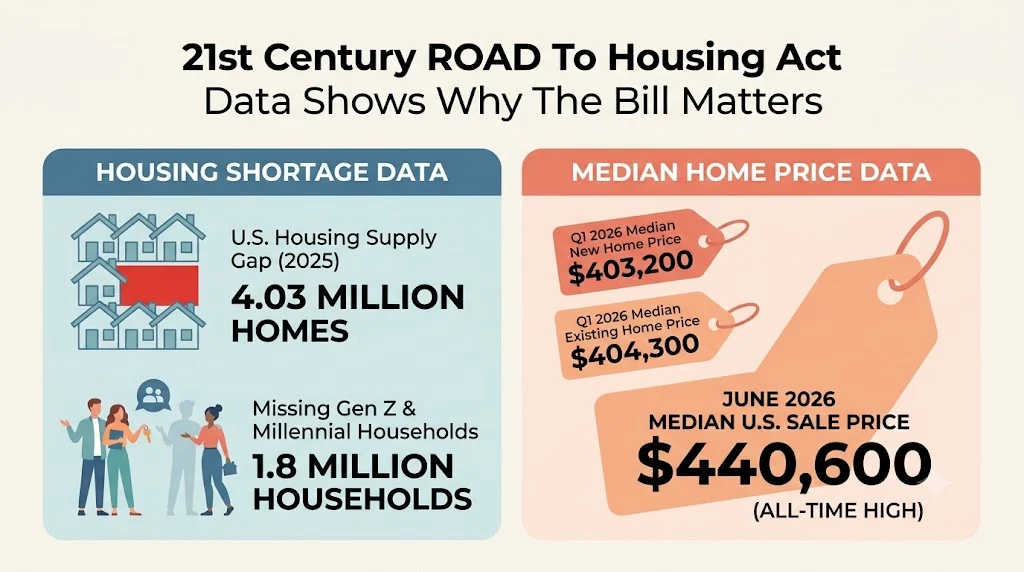
The housing market already faces a major shortage. Realtor.com says the U.S. housing supply gap reaches 4.03 million homes in 2025. It also says 1.8 million Gen Z and millennial households are missing because many young adults cannot form new households in the current market.
NAHB says the national median new home price stands at $403,200 in the first quarter of 2026. It also says the median existing home price falls to $404,300 from $414,900 in the previous quarter.
AP reports that the median U.S. home sale price reaches $440,600 in June 2026. That is an all-time high in National Association of Realtors data going back to 1999.
| Housing Affordability Data Point | Number |
|---|---|
| U.S. housing supply gap in 2025 | 4.03 million homes |
| Missing Gen Z and millennial households | 1.8 million |
| Senate vote on housing bill | 85-5 |
| House vote on housing bill | 358-32 |
| Q1 2026 median new home price | $403,200 |
| Q1 2026 median existing home price | $404,300 |
| June 2026 median U.S. sale price | $440,600 |
This section works well as an infographic. Use one side for the housing shortage. Use the other side for the vote count.
The new housing law does not work like a rebate check. It focuses on supply. It tries to make it easier to build more homes. It also tries to reduce some federal barriers that slow housing projects.
AP says the law seeks to cut federal housing rules, reduce environmental review burdens, speed up construction, and limit corporate buying of single-family homes. This is important for readers. The bill may help over time. It does not make rent or mortgage payments cheaper next week.
The investor rule is one of the most important parts of the law. The Bipartisan Policy Center says the bill restricts large institutional investors that directly or indirectly own at least 350 single-family homes from buying more new single-family homes. It also allows some build-to-rent exceptions. Those homes must be sold to an individual homeowner after seven years.
This provision gives the article a strong unique angle. Many buyers do not only compete with other families. They also compete with large investors in some markets. The new law tries to push more homes back toward owner-occupants.
The bill also targets local housing bottlenecks. The Bipartisan Policy Center says the law requires Community Development Block Grant recipients to publish a searchable public database of undeveloped land parcels they own.
This can help local reporters and residents. A city may say it has no land for housing. The new database can show what land it actually owns. That creates more public pressure to use empty public land for homes. This is a useful angle that many competitor articles miss.
The law also changes some review rules. The Bipartisan Policy Center says the law lets HUD treat some housing assistance as “special projects” under NEPA. It also expands categorical exclusions for some federally supported housing activities.
This does not remove every review. It does not override every local rule. But it can reduce delays for some projects. For builders, time is money. A shorter review can reduce holding costs. That can help some projects move from paper to construction.
The 21st Century ROAD to Housing Act also supports factory-built homes. The Bipartisan Policy Center says the law removes the permanent chassis requirement for manufactured homes. It also directs HUD to review FHA construction financing barriers for modular housing.
This matters because manufactured and modular homes can cost less than many site-built homes. They can also move faster through production. This part of the law may help rural areas, small towns, and entry-level buyers first.
The law also targets small-dollar mortgages. The Bipartisan Policy Center says the bill allows HUD to create a four-year FHA pilot program for mortgages under $100,000. It also directs the CFPB to study compensation rules and fee thresholds that may limit small-dollar mortgage lending.
This issue matters in lower-cost markets. A bank may not want to originate a small mortgage if the profit is too low. That can hurt buyers who want to purchase cheaper homes. The pilot may help more lenders offer small loans.
The law also helps some renters and disaster-hit communities. The Bipartisan Policy Center says the final bill lifts the Rental Assistance Demonstration program cap by 100,000 units. It also authorizes the Community Development Block Grant Disaster Recovery program for three years.
This is not only a homebuyer bill. It also touches renters, public housing, rural housing, and disaster recovery. The National Low Income Housing Coalition says the bill contains 59 housing provisions. These provisions cover housing supply, disaster recovery, manufactured housing, mortgage financing, rural housing, veteran housing, and community banking.
The new law has limits. It does not lower mortgage rates. It does not solve labor shortages. It does not fix local zoning by itself. It does not stop insurance costs from rising. It does not create millions of homes overnight.
AP also notes that the law does not address every cause of the housing crisis. It points to worker shortages, insurance costs, and wages that do not rise fast enough for buyers and renters. This is the honest reader service angle. The law can help supply over time. It cannot give instant relief to every renter or buyer.
The timing matters. The Census Bureau says the national rental vacancy rate stands at 7.3% in the first quarter of 2026. It also says the homeowner vacancy rate stands at 1.1%. The homeownership rate stands at 65.3% in the first quarter of 2026. That is not much different from 65.1% one year earlier.
These numbers show a frozen market. Many renters cannot buy. Many owners do not move. Builders face high costs. Buyers face record prices. That is why a supply-focused law matters even if it works slowly.
The first benefits may not go to every family at once. Builders may benefit first because the law reduces some project barriers. Local governments may benefit through grants and planning tools. Manufactured housing firms may benefit from rule changes. Some buyers may benefit later if more homes enter the market.
Renters may see slower benefits. The law needs time to create new units, preserve assisted housing, and move projects through local approval. First-time buyers may benefit most in markets where the investor rule reduces pressure from large buyers.
Trump’s delay changes the political story around the law. A normal signing ceremony would give both parties a shared housing win. The delay turns the law into a fight over Trump’s priorities.
The bill still becomes law. But the message changes. Congress shows it can pass a major housing bill. Trump shows he wants voting legislation first. Voters see housing affordability and election policy collide in real time. That is the unique political angle. The law is bipartisan. The delay is partisan. The impact will be local.
The bipartisan housing bill becomes law despite Trump’s delay. But the law now faces the real test. HUD must write rules. Local governments must use the tools. Builders must start projects. Lenders must test small-dollar mortgages. Communities must decide whether they want more housing or more delay.
The 21st Century ROAD to Housing Act gives Washington a rare housing deal. It does not end the housing crisis in one move. The next question is simple. Can the new law turn political agreement into actual homes?