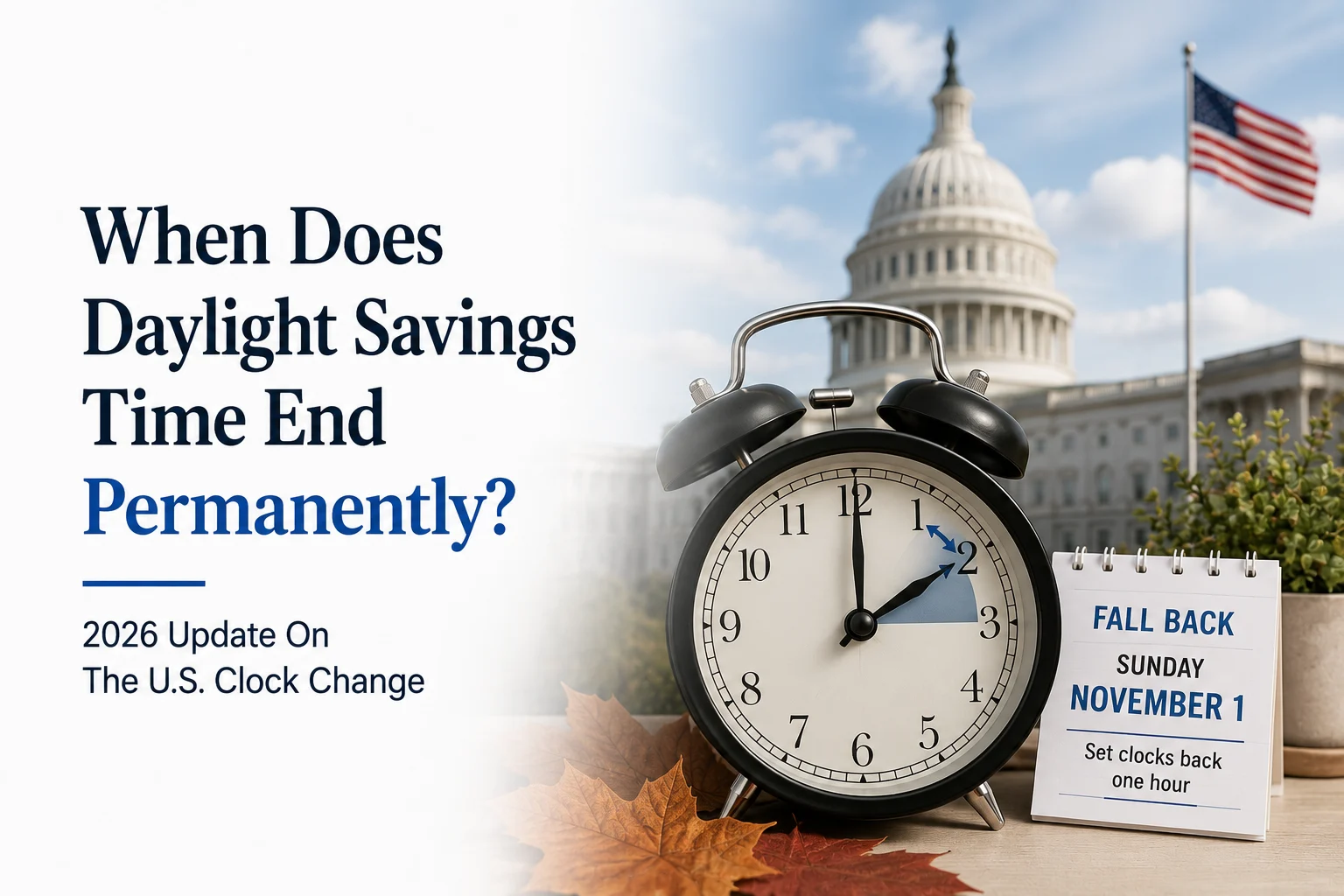
When Does Daylight Savings Time End Permanently? 2026 Update On The U.S. Clock Change
 AND Editorial Team
Daylight saving time does not have a permanent end date in the United States right now. The current law still keeps the twice-yearly clock change. Most Americans still move clocks forward in March and move clocks back in November. Timeanddate says daylight saving time in most of the U.S. starts on the second Sunday in March and ends on the first Sunday in November.
So the direct answer is simple. Daylight saving time does not end permanently yet. Congress must pass a new federal law before the national clock change can stop.
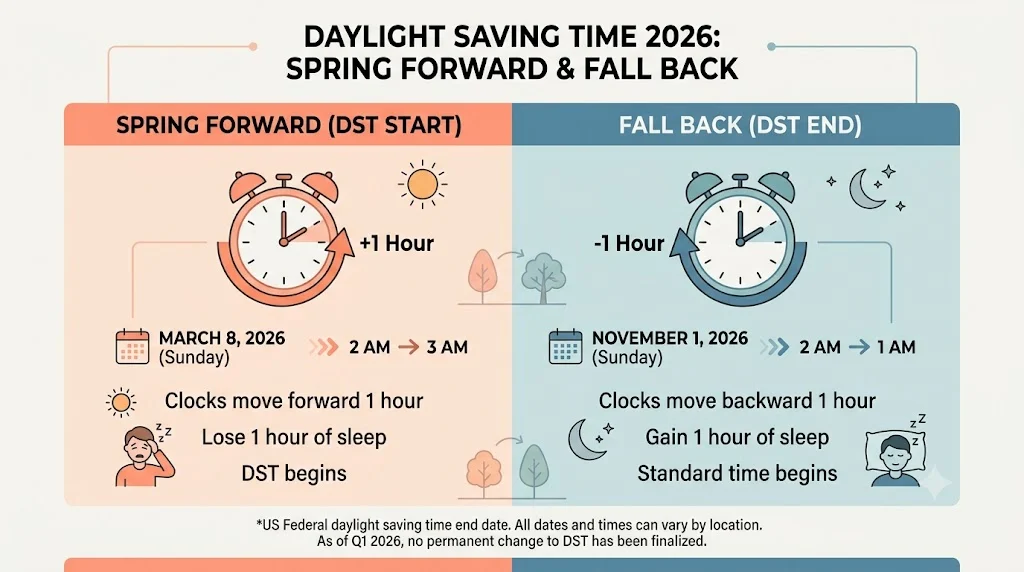
Daylight saving time 2026 ends on Sunday, November 1, 2026. Clocks move back one hour at 2 a.m. local time. This means 2 a.m. becomes 1 a.m. People get one extra hour of sleep that night. Timeanddate lists November 1, 2026 as the U.S. daylight saving time end date.
| Daylight Saving Time 2026 Detail | Date Or Status |
|---|---|
| DST starts in 2026 | Sunday, March 8, 2026 |
| DST ends in 2026 | Sunday, November 1, 2026 |
| Time of clock change | 2 a.m. local time |
| Clock direction in November | Back one hour |
| Permanent end date | No date yet |
| Federal change passed | Not yet |
This table can become an infographic. Use one side for “spring forward” and the other side for “fall back.”
Also Read: Bipartisan Housing Bill Becomes Law Despite Trump’s Delay
Daylight saving time does not end permanently because Congress has not passed a final law. Reuters reports that the U.S. House is scheduled to vote on the Sunshine Protection Act in July 2026. The bill would make daylight saving time permanent across the country. It already passed the House Energy and Commerce Committee by a 48-1 vote. But it still needs full congressional approval.
That is the key point. A bill moving forward is not the same as a law. Until the House and Senate pass the final version and the president signs it, the current clock change continues.
The Sunshine Protection Act is the main bill in the current debate. Reuters says the bill would make daylight saving time permanent. It would also allow states to opt out. Supporters say it can reduce clock-change disruption and give people more evening daylight. Critics warn that it can create very dark winter mornings in some states.
This is why the debate does not move fast. Many lawmakers agree that people dislike changing clocks. But they do not agree on the replacement. Some want permanent daylight saving time. Others want permanent standard time. Some want states to decide.
No state can fully adopt permanent daylight saving time by itself. USAFacts says 19 states have laws or resolutions to move to permanent daylight saving time. But those states still need a federal law change before they can use permanent daylight saving time. This means state bills often work like trigger laws. They show what a state wants to do. But they do not override federal time law.
Hawaii and most of Arizona already stay on standard time all year. AP reports that only Arizona, except the Navajo Nation, and Hawaii opt out of daylight saving time. These places do not move clocks forward and back like most of the country.
This is different from permanent daylight saving time. Hawaii and most of Arizona use permanent standard time, not permanent daylight saving time.
The debate has two main options. Permanent daylight saving time keeps later sunsets. It gives more evening light. But it can make winter sunrise much later. Permanent standard time gives more morning light. Sleep experts often prefer it because it better matches the body’s natural clock. But it makes summer sunsets earlier.
AP reports that this split keeps the U.S. debate stuck. Many people dislike clock changes, but they do not agree on which permanent time should replace them.
Many people think farmers started daylight saving time. That is not true. Daylight saving time first grew during wartime energy debates. Reuters says the U.S. adopted daylight saving time in 1918 to conserve fuel.
Farmers often opposed the clock change. Farm work follows sunlight, animals, dew, and weather. Cows do not change milking time because a clock changes. Crops do not follow a wall clock. This is a useful myth-busting section. It gives the reader a clear answer that many competitor articles skip.
Farmers opposed daylight saving time because it made daily work harder. Morning dew can delay harvesting. Animals follow feeding and milking routines. Markets, trains, and buyers follow clock time. This created a mismatch between farm time and business time. So the farmer story needs correction. Daylight saving time was not mainly created to help farmers. It was linked to energy saving, business hours, and wartime planning.
The current U.S. daylight saving schedule comes from federal law. Timeanddate says the current U.S. schedule was introduced in 2007 under the Energy Policy Act of 2005. It says daylight saving time starts on the second Sunday in March and ends on the first Sunday in November. This gives the U.S. a long daylight saving period. It runs for almost eight months each year.
| Event | Date |
|---|---|
| Daylight saving time starts | March 8, 2026 |
| Clocks move forward | 2 a.m. local time |
| House vote expected on Sunshine Protection Act | July 2026 |
| Daylight saving time ends | November 1, 2026 |
| Clocks move back | 2 a.m. local time |
| Permanent end of clock changes | Not approved yet |
Reuters reports that the House vote is expected next week from July 9, 2026 reporting. If the House passes the bill, the Senate still needs to reconsider it.
If Congress passes permanent daylight saving time, most people would stop changing clocks twice a year. The biggest change would happen in winter. Many places would keep later sunsets. But many places would also see later sunrises.
This matters for schoolchildren, morning commuters, workers, and people who drive before sunrise. Reuters reports that critics raise concerns about dark winter mornings and safety for children.
The U.S. already tested year-round daylight saving time in the 1970s. Reuters says the 1974 permanent daylight saving time experiment became unpopular and was short-lived.
That history matters today. Supporters see more evening daylight as a win. Critics remember the dark winter mornings. This is one reason Congress still debates the issue.
People should still prepare for the normal fall clock change. Most U.S. clocks go back one hour on Sunday, November 1, 2026. Phones and computers usually update automatically. Manual clocks, microwaves, ovens, car clocks, and wall clocks may need changes.
People should also check sleep schedules. The fall change gives an extra hour, but it can still affect sleep, children, pets, work shifts, and travel.
Answer: It does not end permanently yet. No final federal law has stopped the twice-yearly clock change.
Answer: Daylight saving time 2026 ends on Sunday, November 1, 2026, at 2 a.m. local time.
Answer: No. Reuters reports that the bill is moving in Congress, but it still needs full approval before it changes the national clock rule.
Answer: Many states support permanent daylight saving time, but they cannot use it without federal approval. USAFacts says 19 states have laws or resolutions for permanent daylight saving time.
Answer: Hawaii and most of Arizona do not observe daylight saving time. They stay on standard time.
Answer: Farmers did not start daylight saving time. The U.S. adopted daylight saving time in 1918 for fuel and wartime energy reasons. Many farmers opposed it because farm work follows the sun, animals, and weather.
There is no permanent end date for daylight saving time in the U.S. as of July 2026. The next scheduled end date is November 1, 2026. The Sunshine Protection Act may change the future schedule if Congress passes it. But until that happens, Americans should expect the normal clock changes to continue.