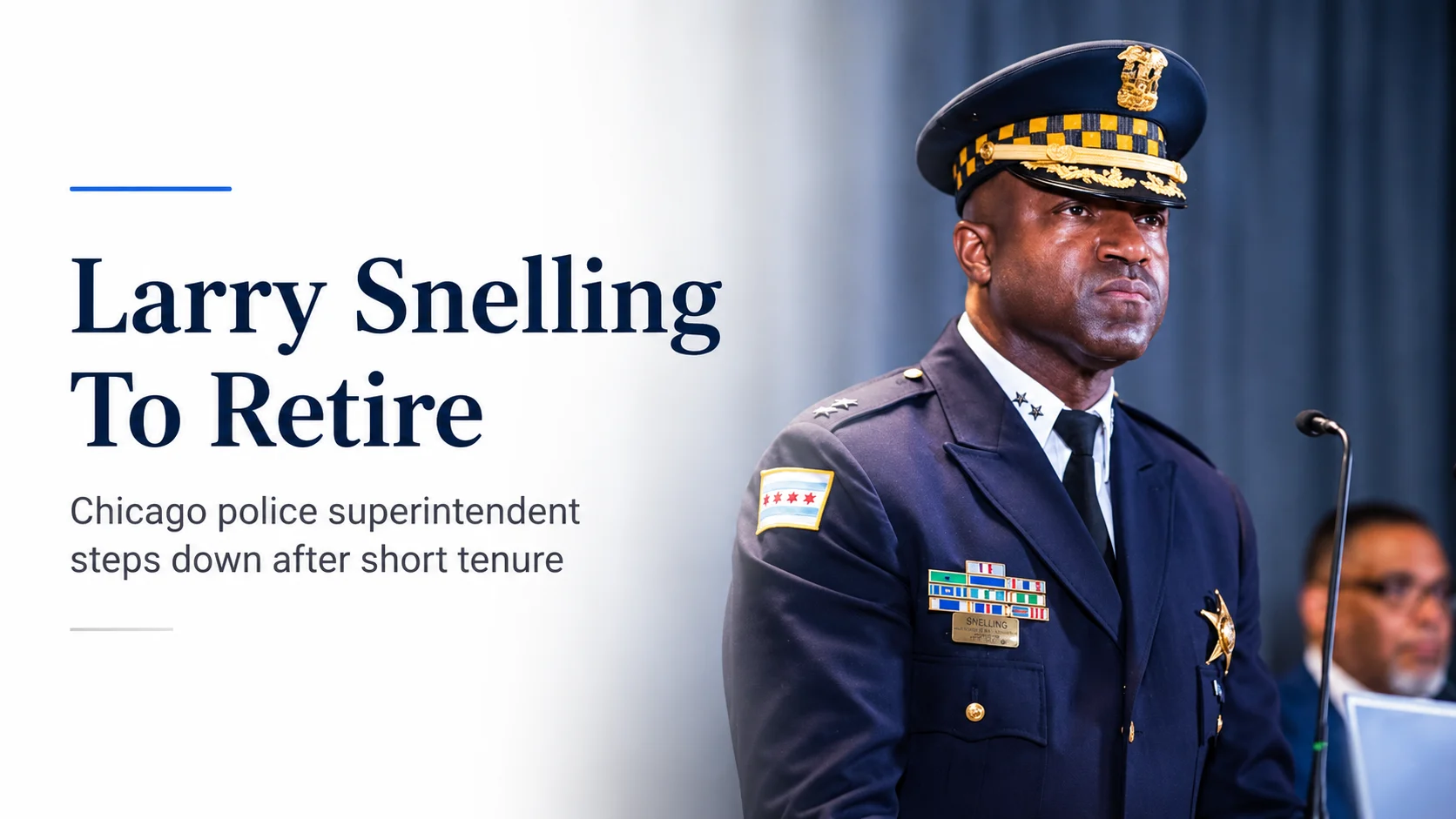
Chicago Police Superintendent Larry Snelling To Retire After Short Tenure
 AND Editorial Team
Chicago Police Superintendent Larry Snelling announces his retirement after a short but important run as the city’s top cop. His last day is July 15, 2026. WTTW reports that he leaves after more than three decades with the Chicago Police Department and nearly three years as superintendent.
This move of Larry Snelling gives Chicago a sudden leadership change. It also gives Mayor Brandon Johnson another big police decision at a sensitive time.
Snelling does not give a clear public reason for his decision. AP reports that his statement thanks Chicago residents and community partners but does not explain what causes him to retire now.
That missing reason is part of the story. A police chief can retire for personal reasons. But a two-week exit from one of America’s largest police departments always creates questions.
Also Read: David Streever ICE Warning Sparks Free Speech Fight Over Email Criticizing Agency
Fred Waller will lead the department on an interim basis after Snelling leaves. Waller already knows the job. Axios reports that he served as interim superintendent after David Brown left in 2023. This gives City Hall a safe short-term option. It also avoids a full leadership vacuum during summer.
That matters because summer often brings more street violence in Chicago. A weak handoff can hurt police planning, patrol work, and public trust.
Snelling leaves at a key time for Chicago. WTTW reports that his departure sets up a major decision before Chicago’s next mayoral election season. The city’s appointment process requires the Community Commission for Public Safety and Accountability to review candidates and send finalists to the mayor. The mayor then picks a nominee who must win City Council approval.
That process can take time. So the city does not only need a new police leader. It needs a leader who can pass political review, win police department respect, and answer community concerns.
Also Read: Chris Brown Ordered To Pay $13 Million To Housekeeper In Housekeeper Dog Attack Case
Snelling leaves with a mixed but important crime record. AP reports that murders and shootings are down so far in 2026 by 32% and 41% compared with 2023.
That gives Snelling a strong public safety point. But crime data needs careful reading. A drop from 2023 does not mean every month improves. It also does not mean every neighborhood feels safe.
Chicago still faces deep gaps in safety. Some areas see more violence than others. That is why Snelling’s record cannot rest on one citywide number.
The strongest part of Snelling’s record comes from 2025. ABC7 Chicago reports that the city had 416 murders in 2025. That was the fewest since 1965, based on preliminary police data. The same report says Chicago had 1,471 shooting incidents in 2025, down from 2,274 in 2024.
Those numbers give City Hall a clear message. Violence falls during Snelling’s time in charge. But Snelling does not take all credit alone. He points to partnerships, internal CPD leadership, and intelligence-led policing.
That point matters because police chiefs often get too much blame when crime rises and too much credit when it falls. Chicago’s safety picture also depends on schools, jobs, street outreach, courts, guns, and neighborhood trust.
Snelling is not an outside hire who comes and leaves fast. He grows up on Chicago’s South Side. AP reports that he joins CPD in 1992 as a patrol officer and later becomes the department’s counterterrorism chief.
WTTW reports that he grows up in Englewood, graduates from Englewood High School, and later attends DePaul University. He spends much of his career as an instructor in the CPD training academy.
That background makes his exit different. Snelling represents an inside path to power. He starts in the same city he later polices. He also works inside the training system that shapes new officers.
Snelling also leads CPD through the 2024 Democratic National Convention. AP reports that officers receive constitutional policing and de-escalation training before the event. A smaller group also receives training for civil unrest and riot response.
Axios reports that protests during the DNC remain mostly peaceful and police largely avoid violent clashes with demonstrators. That becomes a major public image win.
Chicago’s past convention history carries heavy meaning because of 1968. So a calmer 2024 DNC gives Snelling a strong line in his record.
Snelling does not leave behind a finished department. AP reports that he leads CPD while it works under a federal consent decree. The court-monitored plan requires more community policing and more use-of-force training after a Justice Department report finds civil rights abuses inside the force.
This is one of the most important parts of the story.
A new superintendent must fight crime and reform the department at the same time. That is hard because some residents demand tougher policing while others demand tighter checks on police power. The next chief must handle both sides without losing trust.
Snelling also works through political friction. Axios reports that he supports keeping ShotSpotter even as Mayor Johnson ends the city contract in 2024.
That matters because it shows a real split between police strategy and mayoral policy. Axios also reports that critics question how clearly Snelling explains CPD’s interactions with federal immigration agents during raids.
This is another key issue for Chicago. The city has strong rules against local police helping federal immigration work. Any confusion can hurt trust in immigrant communities.
Mayor Brandon Johnson now owns the next move. Snelling was Johnson’s first pick for police superintendent. Axios reports that Johnson chose him and that Snelling led during a major drop in homicides.
So the next hire becomes a test of Johnson’s public safety plan. If he picks a reform-heavy leader, police union voices may push back. If he picks a hardline policing leader, community groups may push back. If the search takes too long, critics can blame City Hall for slow action.
The next superintendent must also handle crime, morale, reform, street protests, federal pressure, and election-year politics.
Chicago now watches four things.
Snelling’s exit does not close the public safety debate in Chicago. It starts a new one. The next leader inherits lower violence numbers, unfinished reform work, officer morale issues, and a city that still wants safety without losing trust.