 Rahul Patel
Oil prices just took their biggest single-day drop in months. The reason is a peace deal between the United States and Iran that could reshape energy markets for the rest of the year. If you drive a car, heat your home, or fly anywhere this summer, this story is directly about you.
Here is exactly what happened, according to the White House and confirming reports.
President Donald Trump announced on Sunday, June 14, 2026, that the US has finalized a framework deal with Iran. The agreement ends a period of conflict and reopens the Strait of Hormuz. This narrow waterway carries roughly 20 percent of the world’s oil supply. The moment the news broke, oil markets reacted fast and hard.
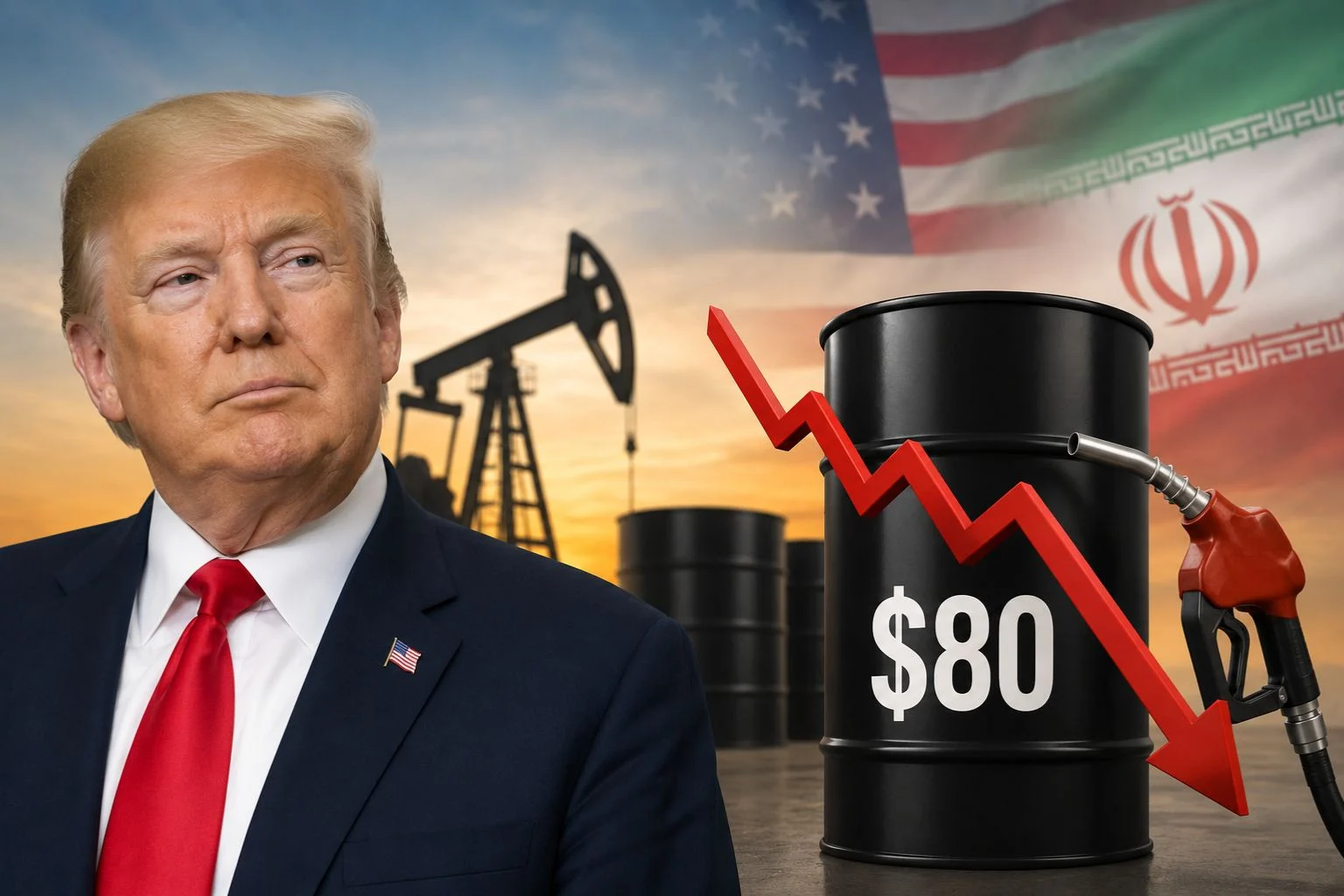
As of 2:30 PM ET on June 14, 2026, US crude oil futures dropped as much as 5.5 percent to trade near $80.15 per barrel. That briefly touched levels not seen since early March. Brent crude, the international benchmark, fell roughly 4.1 to 5.1 percent. It settled between $82.87 and $83.75 per barrel, according to Reuters and Bloomberg data.
To put that in plain terms: oil has now fallen about $25 from its peak just one month ago. That is a big move for a commodity that affects the price of nearly everything Americans buy.
Energy stocks felt the pressure immediately. In London, BP dropped 3.8 percent and Shell fell 3.7 percent. The Stoxx 600 Energy index in Europe was down 2.3 percent within minutes of opening.
For everyday Americans, this is good news. Lower oil prices feed directly into lower gas prices at the pump, cheaper airline tickets, and lower costs for businesses that ship goods.
Before the conflict began, roughly 20 percent of all global oil shipments moved through the Strait of Hormuz every single day. When Iranian attacks disrupted tanker traffic in early March, it triggered what analysts call the largest oil supply shock in modern history. The disruption ran for nearly three months and drove crude prices to painful highs.
Trump announced Sunday that the US naval blockade of Iran will be lifted. The strait will reopen toll-free. The official signing ceremony is scheduled for Friday, June 19, 2026, in Switzerland.
Pakistan Prime Minister Shehbaz Sharif, who served as mediator, confirmed that the US and Iran have declared an immediate and permanent end to military operations on all fronts, including Lebanon.
“Ships of the World, start your engines,” Trump posted on Truth Social. “Let the oil flow!”
This is the part most Americans actually care about.
According to AAA and GasBuddy data as of June 14, 2026, the national average retail gasoline price has dropped below $4 per gallon. Patrick De Haan, head of petroleum analysis at GasBuddy, projects further declines toward $3.75 per gallon by July. That assumes the peace framework holds and oil flows resume normally.
That would mark a real drop from the highs Americans were paying during the height of the conflict. Here is what that means for a typical family:
| Vehicle | Tank size | Weekly fills at $4.00 | Weekly fills at $3.75 | Monthly savings | Yearly savings |
|---|---|---|---|---|---|
| Standard SUV | 18 gallons | $72.00 | $67.50 | $18.00 | $216.00 |
| Family sedan | 14 gallons | $56.00 | $52.50 | $14.00 | $168.00 |
For a family filling up once a week, the math adds up fast.
The broader economic ripple is also significant. Cooling crude prices have already eased some of the inflation pressure squeezing American households. There is now growing speculation that the Federal Reserve may pause its planned interest rate hikes in response.
Before you fill up expecting $2 gasoline, here is what the futures market is signaling about the months ahead.
Trump has repeatedly promised oil prices will “drop like a rock” once peace is secured. The announcement has already delivered a major drop. But the market is signaling something different about what comes next.
According to CME Group futures data, contracts extending out to next year and beyond have barely moved. The futures market currently does not show oil prices falling below $70 per barrel until late 2031. That tells you something important. Traders believe the easy drop has already happened. The road back to pre-war prices will be long and complicated.
Why? Three specific reasons.
First, the strait is mined. Iran mined the waterway during the conflict. Only two narrow passageways remain open along opposite coastlines. Minesweeping operations could take several weeks before traffic can move safely at any real volume.
Second, the tankers are not ready. Only a few dozen vessels are currently near the strait and ready to load oil. The typical number is about 100. It could take 30 days or more to get enough ships in place to restore anything close to normal flows. That estimate comes from Vikas Dwivedi, global oil and gas strategist at Macquarie Group.
Third, the oil wells themselves need time. Middle Eastern production was largely shut off during the conflict. Restarting wells is not like flipping a switch. It is a complex engineering process that can take weeks. And there is no guarantee a well produces the same volume after being shut down.
Dan Pickering, founder of Pickering Energy Partners, summed it up plainly: “We will figure out what the new normal is. But it is not going to be $2.85 gasoline.”
During three months of disrupted supply, countries around the world burned through their emergency oil reserves at a historic rate. Those reserves now need to be refilled.
Experts estimate that refilling global stockpiles could require more than 1 million barrels per day of additional demand. Total purchases could reach around 1 billion barrels of crude, regardless of the price.
That sustained demand will put a floor under oil prices even as supply recovers. In the short term, markets may overshoot and prices could dip below pre-war levels. But the rush to refill strategic reserves will push prices back up. That could happen well before the supply side has fully normalized.
Dwivedi said: “You are going to get hit with a whole lot of demand on the other side of this.”
This is the part of the story that matters most for what Americans pay at the pump six to twelve months from now.
Beyond oil, the broader reaction to the deal has been a significant rally in global equity markets.
South Korea’s Kospi jumped 5.56 percent. Japan’s Nikkei 225 rose 4.90 percent. Dow Jones futures added over 430 points. S&P 500 futures climbed more than 1 percent. Nasdaq 100 futures rose nearly 2 percent.
The message from markets is clear. The end of this conflict is seen as broadly positive for the global economy. Risk appetite is returning.
But Vivek Dhar, commodity markets analyst at Commonwealth Bank of Australia, noted that oil flows through the Strait of Hormuz need to reach 60 to 70 percent of pre-war levels just to return markets to where they were before. That is a high bar, and it will take time to clear it.
The official signing ceremony in Switzerland on Friday, June 19, 2026, is the next major milestone. From there, watch how quickly minesweeping operations progress in the strait. Watch whether ship traffic resumes at any real scale within the first 30 days.
If the deal holds and logistics come together faster than expected, prices at the pump could continue falling through July. If complications arise – with mines, production restarts, or political stability – that progress could stall quickly.
Some analysts, including Vikas Dwivedi at Macquarie Group, estimate two to six months before the Strait of Hormuz returns to full operational capacity. Others caution that timelines remain uncertain.
For now, Americans should see some relief at the pump. The next 30 days – specifically minesweeping progress and tanker availability – will determine whether that relief deepens or stalls.