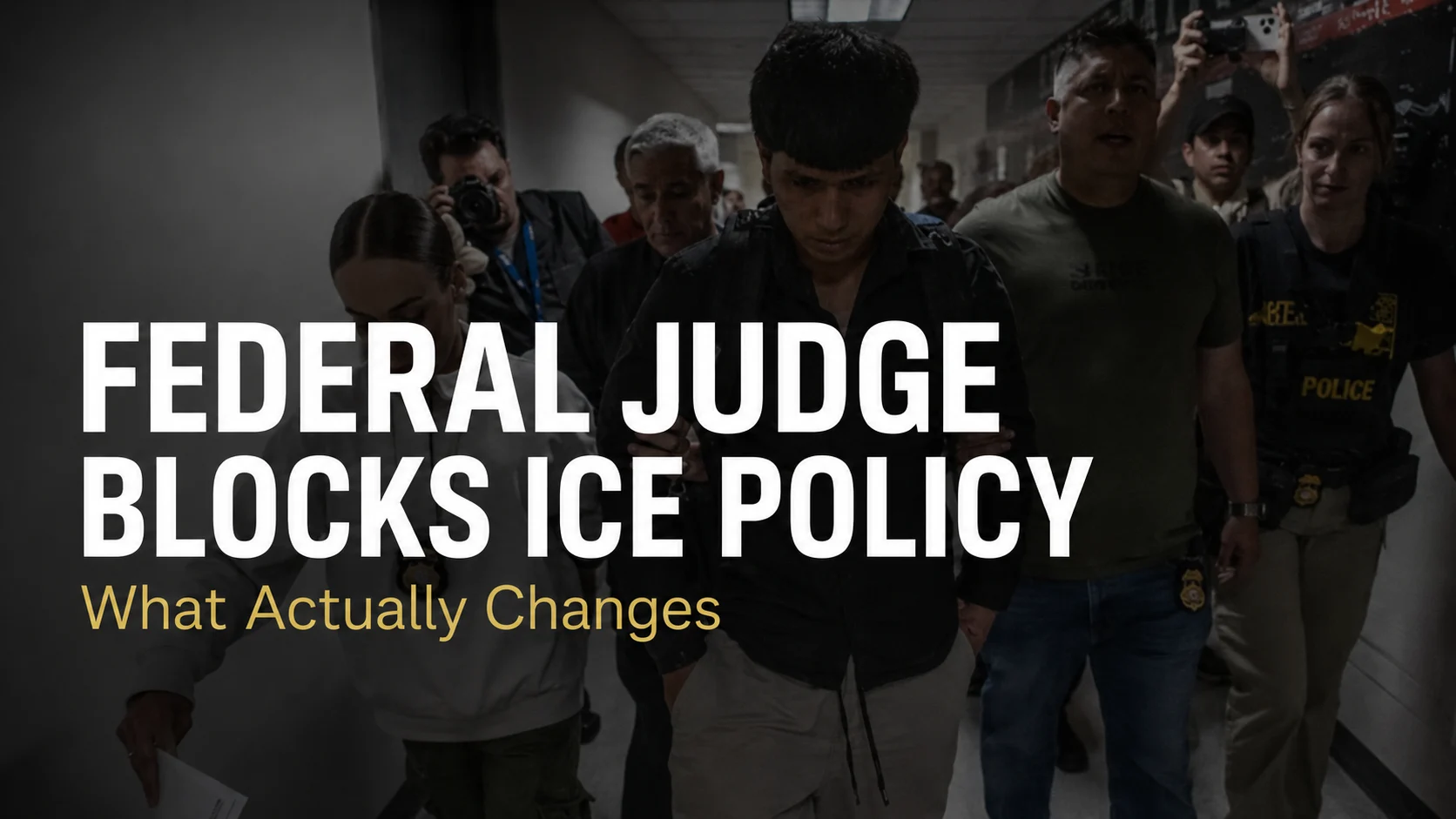
Federal Judge Blocks ICE Courthouse Arrest Policy Nationwide. Here's What Actually Changes
 AND Editorial Team
A federal judge has blocked Immigration and Customs Enforcement (ICE) from making broad arrests inside immigration courthouses across the country . The ruling came from U.S. District Judge P. Casey Pitts in California on June 23, 2026 .
The decision is a major setback for the Trump administration’s deportation efforts . But the ruling is less sweeping than many headlines suggest. It does not ban all courthouse arrests. It simply restores older, stricter limits .
Supporters say the ruling protects due process. Critics call it judicial overreach. Here is what actually changes and what stays the same.
Judge Pitts did not declare all courthouse arrests illegal . Instead, he found that federal agencies broke the law when they changed their policies .
The case focused on the Administrative Procedure Act . This is a federal law that requires agencies to explain major policy changes. The judge said ICE failed to provide “reasoned explanations” for why it reversed course .
The ruling vacates two specific policies:
The judge called the administration’s decision-making “arbitrary and capricious” . He wrote that the policies “entirely fail to address the chilling effect of courthouse arrests on noncitizens’ attendance at court proceedings” .
For years, ICE generally restricted courthouse arrests. The agency limited them to specific circumstances like national security threats, public safety risks, and “hot pursuit” of dangerous individuals .
The Trump administration changed that in 2025 . It rescinded the old guidance and allowed broader arrests. ICE began detaining migrants in courthouse hallways, sometimes moments after they finished their hearings .
This created dramatic scenes. Masked ICE agents would wait in courthouse hallways. Migrants attending routine check-ins would be taken into custody on the spot . A former immigration judge reported a “dramatic decline” in hearing attendance after the policy took effect .
The ruling reinstates the older, stricter policy . ICE can still make arrests at courthouses, but only in limited circumstances. These include cases involving public safety threats, national security risks, or other specific exceptions .
The ruling also strikes down the detention waiver. Previously, ICE could hold detainees in short-term facilities for up to 72 hours. Now the 12-hour limit is back in effect .
The ruling applies nationwide . This goes further than a similar ruling in New York last month, which applied only to two Manhattan courthouses .
This ruling does not ban ICE from making arrests at courthouses entirely . Targeted enforcement actions can still occur under the older 2021 guidance .
The ruling also does not affect arrests at non-immigration courthouses. It only applies to immigration courts .
The judge made this distinction clear. He wrote that “vacatur does not preclude ICE from conducting civil enforcement actions at courthouses; it merely reinstates ICE’s 2021 guidance” .
Most news stories focus on the political debate. But there is a deeper legal story here that deserves attention.
This ruling is about process, not policy.
The judge did not say courthouse arrests are unconstitutional. He did not say they are inherently wrong. He said the administration failed to follow the rules when it changed them .
The Administrative Procedure Act has been on the books for 80 years . It requires agencies to “think before they act” . The judge found that ICE did not think. It simply reversed course without explaining why .
This matters because it is a pattern. Federal courts have blocked several Trump administration policies on procedural grounds. The pattern shows that courts are increasingly focused on how agencies make decisions, not just what they decide.
The hidden angle: This ruling may be less about immigration and more about the future of executive power. If agencies can change policies without justification, they can bypass Congress and the courts. The judge’s ruling reinforces that agencies must follow the law, even when they have political support.
The ruling arrives as immigration remains a top political issue . Supporters and critics have reacted sharply.
Supporters say the ruling protects due process . They argue that people should be able to attend hearings without fear of immediate detention. The Lawyers’ Committee for Civil Rights called immigration courts “places of due process, not hunting grounds” .
Critics accuse the judge of interfering with enforcement . James Percival, the Department of Homeland Security’s general counsel, called it “naked judicial activism in service of an anti-American, open borders agenda” .
Governor Ron DeSantis also criticized the ruling. He wrote that it was “yet another example of partisan judges throwing sand in the gears of immigration enforcement” .
The Trump administration is expected to appeal . The case could move quickly through higher courts because of its nationwide impact.
If appellate courts intervene, the policy could be reinstated while litigation continues . The administration has not yet announced an appeal, but legal experts expect one .
For now, the ruling is in effect nationwide. Immigration courts will return to the older, stricter limits on arrests .
The ruling is a significant setback for the administration’s deportation efforts. But it is not a complete ban on courthouse arrests. It reinstates older limits and requires agencies to follow proper procedures.
The hidden story is about process, not politics. Courts are increasingly requiring agencies to justify their decisions. This ruling may be remembered less for immigration policy and more for the limits it places on executive power.