Adrian Boafo Wins Maryland House Primary After $11 Million Outside Spending Blitz
 AND Editorial Team
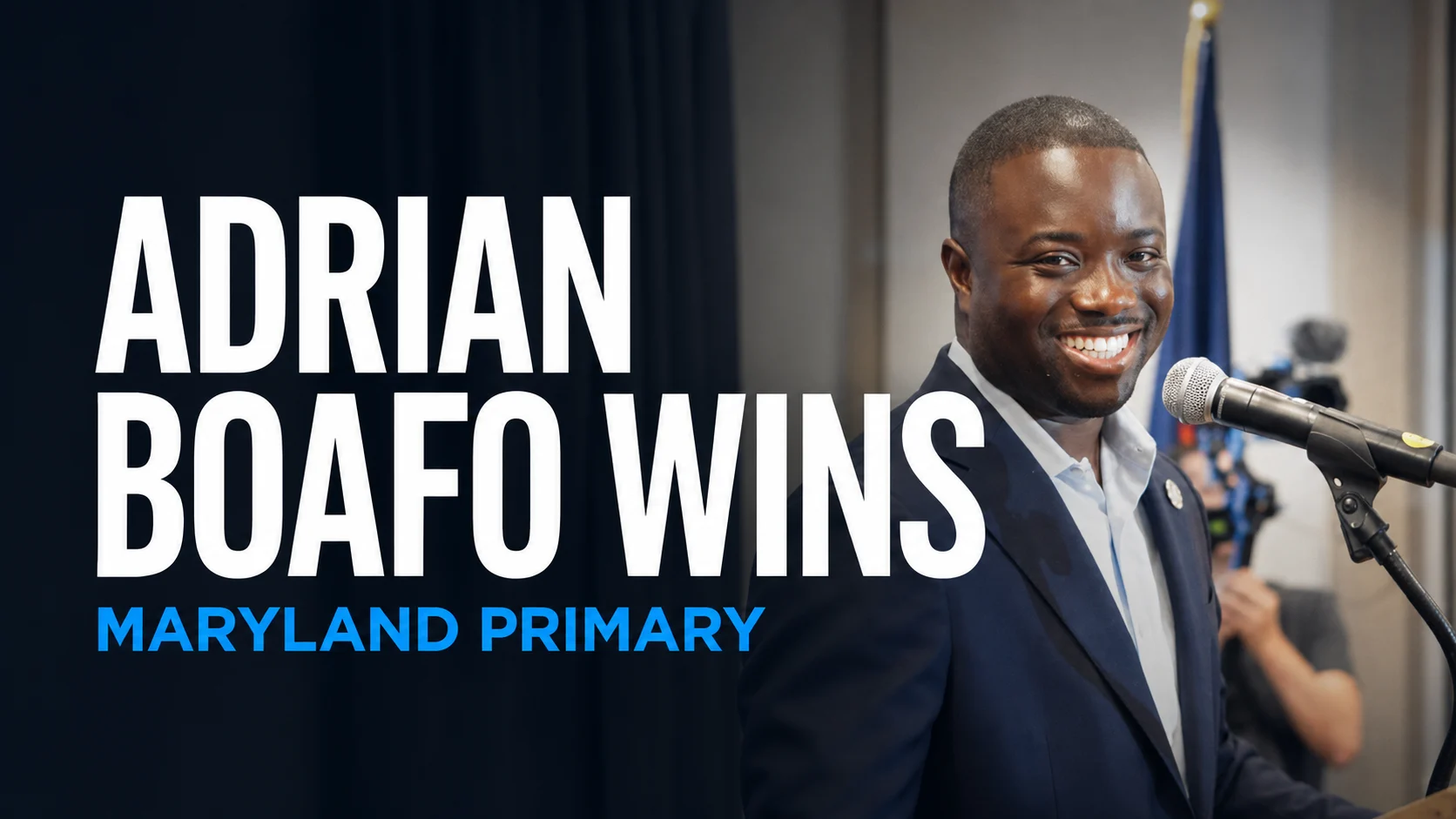
Maryland state delegate Adrian Boafo won the Democratic primary for Maryland’s 5th Congressional District on June 23, 2026 . He defeated a crowded field of 24 candidates . The seat opened after Representative Steny Hoyer announced his retirement . Hoyer had represented the district since 1981 .
Boafo secured about 32 percent of the vote . Quincy Bareebe placed second with about 19 percent . Harry Dunn, a former Capitol Police officer, came third with about 14 percent .
The primary attracted national attention. Outside groups spent more than $11 million supporting Boafo’s campaign . Pro-Israel and cryptocurrency-aligned groups provided most of this funding . The spending sparked debates about super PAC influence in Democratic elections .
Boafo entered the race with several advantages. He had Hoyer’s endorsement . He was Hoyer’s former campaign manager and had worked as his aide . Governor Wes Moore and Senator Angela Alsobrooks also supported him .
Supporters argued Boafo represented continuity and experience. At 32 years old, he also brought younger leadership to Washington . His campaign focused on affordability, civil rights protections, support for seniors, and economic opportunity .
Boafo previously served on the Bowie City Council . He was elected to the Maryland House of Delegates in 2022 .
Outside groups spent more than $11 million supporting Boafo . Two super PACs accounted for most of this spending.
United Democracy Project, a super PAC affiliated with AIPAC, spent about $5.7 million . Protect Progress, a crypto-industry-backed super PAC, spent about $5.5 million .
These organizations spent millions on advertising and voter outreach . The ads mentioned Boafo’s positions on immigration and the economy . They did not discuss Israel or cryptocurrency .
The spending dwarfed many competitors’ campaign resources. It became one of the most discussed aspects of the election .
The reaction among Democratic activists has been sharply divided.
Critics argue that massive super PAC spending overwhelmed grassroots campaigns . They say outside interests had disproportionate influence on a local congressional race . They believe crypto and pro-Israel organizations shaped the outcome through financial power .
Three rival candidates jointly denounced the interest groups’ efforts . Harry Dunn, Rushern Baker, and Quincy Bareebe took the unusual step of speaking out together .
Senator Chris Van Hollen also accused the groups of trying to buy the seat . He openly questioned what promises Boafo made to secure the funding .
Boafo called Van Hollen’s comments “extremely insulting” . He said “big money has no place in politics” .
Boafo’s supporters argue that endorsements from respected Maryland leaders mattered more than outside spending . They say voters made their own decisions . They point to his experience and local roots .
Hoyer defended Boafo in an ad from United Democracy Project. He said Boafo has the “courage to stand up to any special interests” .
Pro-Israel organizations celebrated the outcome as a victory for candidates who support strong U.S.-Israel relations . Cryptocurrency advocates view the race as evidence the industry is becoming a major force in American politics .
Most coverage missed a key angle. This primary was also a proxy fight between two Democratic giants .
Steny Hoyer supported Boafo . Nancy Pelosi backed Harry Dunn . Pelosi had grown close to Dunn after the January 6 riot .
This was perhaps the final clash of their decades-long rivalry . Hoyer, 87, is retiring after 44 years in Congress . Pelosi also recently stepped back from leadership.
Boafo’s victory was a win for Hoyer . He got his handpicked successor for his seat . This internal party drama shaped the race more than most analysts discussed.
Boafo will now face Republican candidate Chris Chaffee in the November general election . Chaffee won the Republican primary against two opponents .
The district is heavily Democratic . Voters chose Kamala Harris over Donald Trump by 33 percentage points in 2024 . The Cook Political Report rates the race as Solidly Democratic .
Most analysts consider Boafo the clear favorite .
This race may be remembered as a sign of growing special-interest involvement in congressional primaries .
Over recent election cycles, crypto-backed PACs have dramatically increased political spending . AIPAC-affiliated groups have become major players in Democratic primaries . Outside spending has increasingly shaped competitive House races .
The Maryland 5th District contest brought these trends together . It became a test case for both industries’ political influence .
For voters, the debate continues. Does this spending represent healthy political participation? Or does it give special interests too much power over elections?